

Choosing a luxury garden water feature involves matching the style to your garden’s character, sizing the pump correctly (flow rate and head height are the key numbers), and using warm, layered lighting that flatters rather than dazzles. Get all three right, and you’ll have a feature that looks and sounds every bit as good in October as it does in June.
There’s a particular kind of garden magic that happens when moving water is involved. The sound alone changes a space—traffic noise fades, conversations flow more easily, and the whole garden feels more alive. Done well, a water feature brings the kind of atmosphere you’d normally associate with a boutique hotel courtyard or an old Italian piazza. Done badly, it looks like a forgotten garden centre ornament with a slightly worrying hum.
We’ve been designing and installing bespoke garden water features in Essex since 2009, so we’ve seen what works, what doesn’t, and what homeowners wish they’d known before committing to a particular pump or positioning choice. This guide covers the full picture—style, pump, lighting, placement, maintenance, and budget—so you can make genuinely informed decisions before a single spade goes in the ground.
Choosing the right water features for your garden
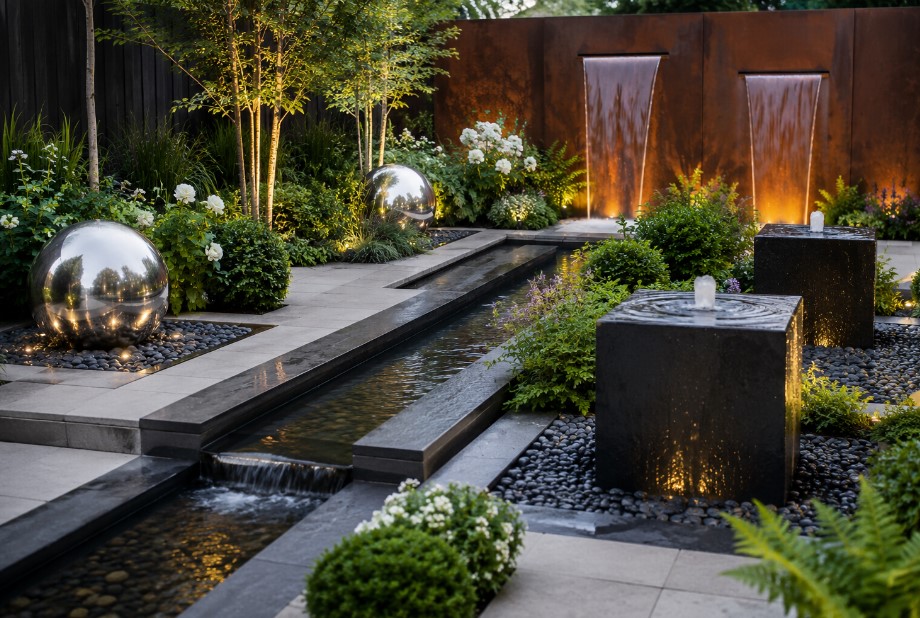
The single biggest mistake people make is choosing a feature they love in isolation, then trying to fit it into a garden that doesn’t suit it. Style compatibility matters enormously.
Modern and architectural: clean lines, stone, steel, and Corten
Sleek raised rills, minimalist cube fountains, mirrored steel spheres, and Corten steel wall blades all belong in this category. They work beautifully in contemporary patios and courtyards, especially when surrounded by structured planting and pale paving. One practical bonus: modern architectural features tend to hide pipework and fittings behind clean facades, which keeps the overall look uncluttered.
Classic and formal: tiered fountains, urns, and symmetry
If your garden leans more traditional—think yew hedging, herbaceous borders, and a classic English lawn—a tiered stone fountain or a pair of matching urn spillers will feel far more at home than a Corten cube. These features complement structured borders beautifully and often age well, developing a naturally weathered patina that adds character rather than looking tired.
Naturalistic ponds and rills: the designed-by-nature look
Informal ponds with planted margins, gentle bog areas, and wildlife-friendly edges are having something of a renaissance. They require more planning than a self-contained fountain—particularly around liner choice, filtration, and planting depth zones—but the result is a living feature that genuinely changes from season to season. We design and install garden ponds as part of our broader aquaculture work, and we’d always recommend getting the groundwork and marginal planting right from the start rather than retrofitting it later.
Rills (those narrow, linear water channels that bisect a garden) sit somewhere between architectural and naturalistic. They work brilliantly as linking devices between different garden levels or zones, drawing the eye across the space.
Wall water features and compact courtyards
For smaller Essex gardens, courtyard spaces, or side passages, a wall-mounted feature is often the smartest choice. They take up almost no floor space, the sound of falling water onto stone or slate can mask urban noise effectively, and many contemporary designs look genuinely impressive at close range. A few popular garden fountain ideas in this category include: spouting lion masks, cascading blade walls, ceramic bowl spillers, and glass panel sheets.
Materials and finishes that look luxe (and stay that way)
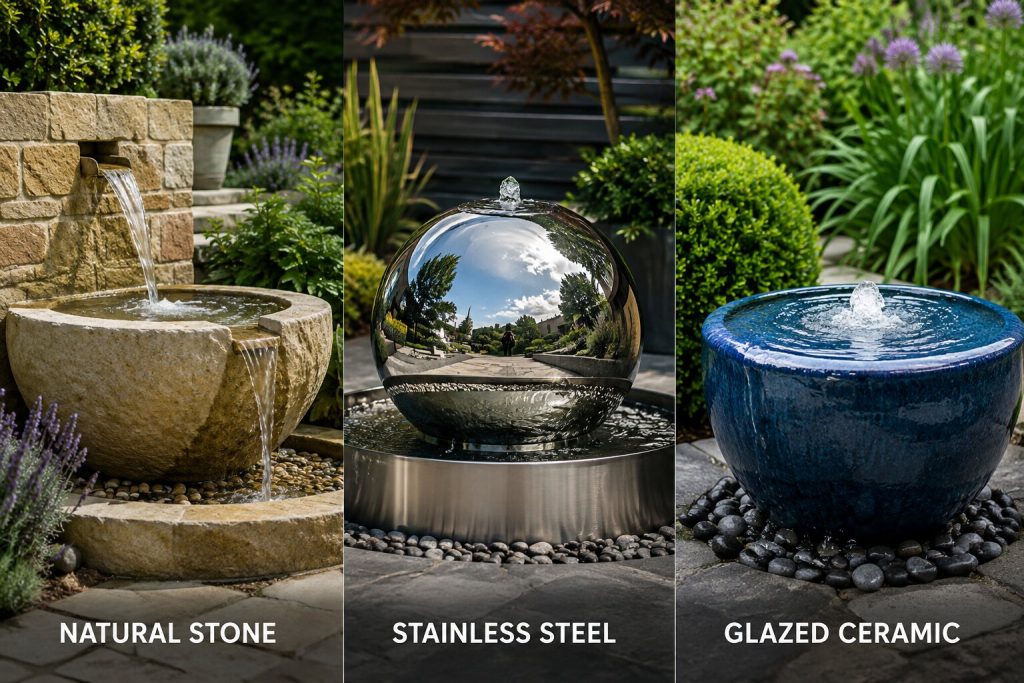
Natural stone—York stone, limestone, slate—ages beautifully but needs sealing to resist algae staining, particularly on horizontal surfaces. Cast stone is considerably more affordable and convincing to the eye, though it tends to absorb moisture, which means frost resistance needs checking for UK winters.
Stainless steel is durable, weather-resistant, and develops a pleasing reflective quality that mirrors the surrounding planting. It does show limescale deposits in hard-water areas like Essex, so descaling becomes part of the maintenance routine.
Ceramics and glazed bowls are popular for their colour and finish options, but they’re vulnerable to frost cracking if water isn’t fully drained before temperatures drop.
One reliable test for any material: ask yourself how it’ll look in February, not just July. A feature that photographs beautifully in summer but looks stained and neglected in winter isn’t money well spent.
Garden water feature pumps: the unglamorous hero
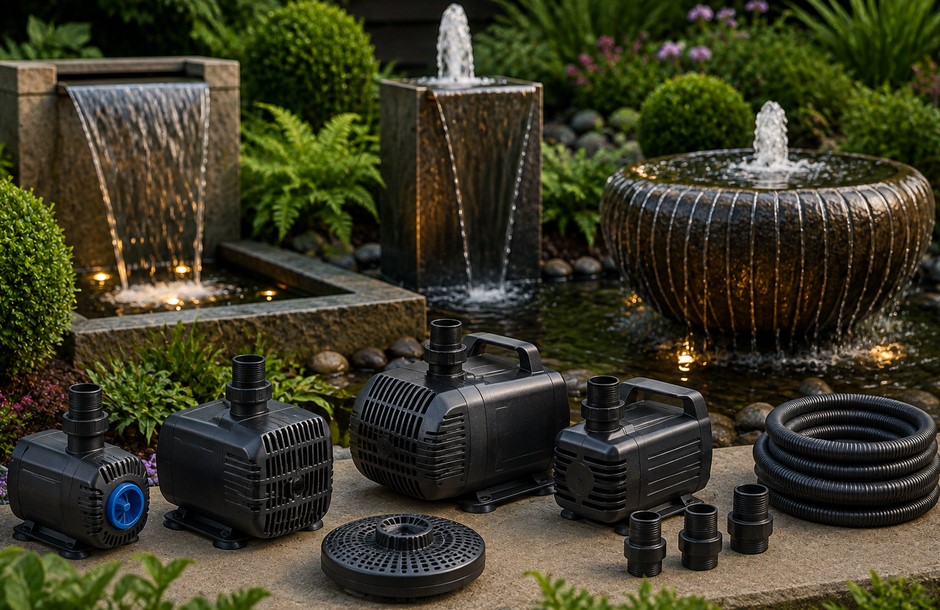
Nobody chooses a pump because they find it exciting. But the pump is what makes everything else work—and getting it wrong is expensive.
Submersible vs external pumps
Submersible pumps sit inside the water reservoir and are the standard choice for most domestic garden water features. They’re relatively easy to install, reasonably quiet, and straightforward to access for cleaning. External pumps sit outside the water in a separate housing. They’re better for higher-output applications—large ponds or complex water circuits—but they need to be housed in a weatherproof enclosure and are generally more involved to install.
Flow rate and head height explained
Two numbers govern pump sizing. Flow rate—measured in litres per minute (LPM)—tells you how much water moves through the pump per minute. As a general rule, the total water volume in your feature should circulate at least once per hour. So divide your total volume in litres by 60 to get the minimum flow rate you need.
Head height is the vertical distance between the water surface and the point where the water exits (your fountain nozzle or spillway lip). Look for the pump’s max head specification—this is the maximum vertical height the pump can push water straight up. The max head must be higher than your actual head height, with some comfortable margin. A pump rated to exactly your head height will work poorly and wear out faster.
Noise, vibration, and keeping things relaxing
A water feature that hums audibly is quickly maddening. Better-quality pumps with magnetic-drive motors run considerably quieter than cheaper equivalents. Positioning the pump on a rubber mat inside the reservoir also reduces vibration transfer significantly.
Energy use and smart controls
Modern brushless pumps are far more energy-efficient than older models. Battery and solar powered pumps are also an ideal eco-friendly option for outdoor features. Solar powered pumps are especially useful where there is no access to a power source. According to Checkatrade (2025), a typical 12W pump running constantly costs less than 8p per day—so energy bills aren’t a major concern for most domestic features. Timers and dusk-to-dawn sensors are worth adding, both for convenience and to extend pump life by reducing unnecessary running hours.
Filters and debris protection
If your water feature sits near planting—which in a well-designed garden it usually will—organic debris will find its way into the pump housing. A pre-filter sponge protects the impeller from leaf matter and grit. We’d always advise building in easy pump access during the design stage, rather than discovering you’ve buried it under three hundred kilograms of paving.
Garden fountain lighting ideas that don’t look like a disco
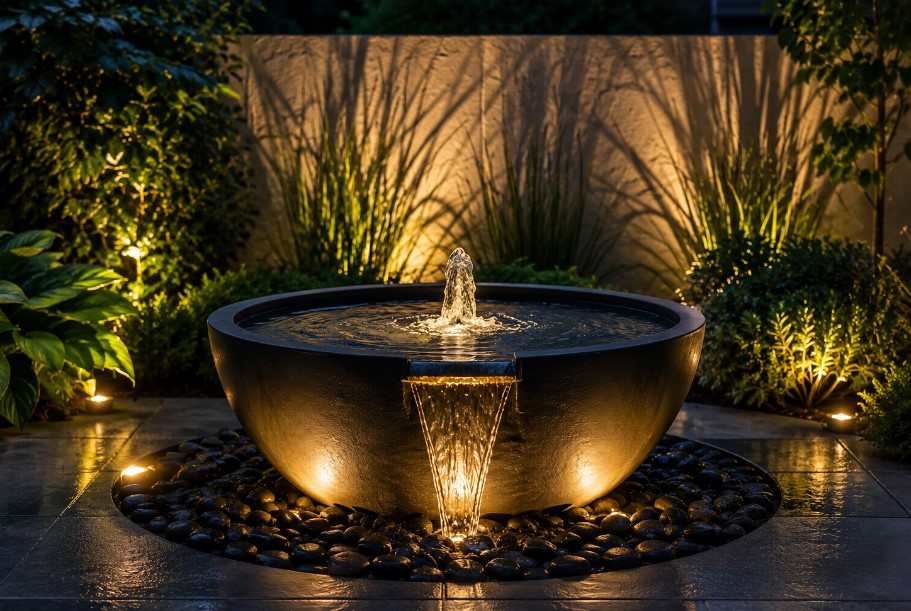
Lighting transforms a water feature from a daytime feature into an evening focal point. It also dramatically increases how much you actually use your garden after dark.
Subtle uplighting vs underwater LEDs
Both have their place, but they create very different effects. Uplighting placed just outside the water casts dramatic shadows and illuminates the movement of water from below the surface without getting wet. Underwater LEDs submerged within the feature create a more theatrical, glowing effect. For luxury gardens, we’d generally lean towards low-level uplighting as the starting point, with underwater LEDs used selectively rather than as the default.
Warm vs cool colour temperature
This is where a lot of lighting schemes go wrong. Cool white LEDs (above 4,000K) give a clinical, slightly harsh quality to stone and water at night. Warm white—around 2,700K to 3,000K—is far more flattering to natural materials, skin tones, and surrounding planting. It’s the difference between a garden that feels welcoming and one that feels like a car park.
Colour-changing RGB LEDs can look impressive in the right setting, but they require restraint. A slow-cycling feature can work in a contemporary courtyard; a full rainbow disco sequence generally doesn’t, regardless of how much the grandchildren enjoy it.
Glare, reflections, and viewing angles from the house
Before committing to any lighting position, stand at your kitchen window or living room door and think about the sightlines. Light sources that sit at eye level when you’re seated can create uncomfortable glare. Position fittings low and angled to minimise direct visibility while maximising the illuminated effect on the feature itself.
Safety and practicalities: IP ratings and cable routes
Any luminaire used in or immediately around water must carry an appropriate IP (Ingress Protection) rating. Fully submersible lights require IP68; fittings sited immediately adjacent to the feature should be at least IP67. All outdoor electrical installations must include an RCD (residual current device) to cut power instantly if a fault is detected. Don’t compromise on this—it’s both a safety requirement and a non-negotiable part of any professional installation.
Cable routes need to be planned at the groundworks stage, buried deep enough to avoid being damaged by future gardening tools.
Layering the scene
The most successful lighting schemes don’t just illuminate the water feature—they light the whole garden composition. Soft uplighting on surrounding planting, low-level pathway lights leading the eye towards the feature, and a gently illuminated backdrop of hedging or a garden wall all contribute to a scene that feels considered rather than spotlit. The water feature becomes the centrepiece of something larger.
Where your water feature should earn its keep
Sightlines from the house matter enormously—position your feature where it can be seen from the kitchen, living room, or dining area. Consider wind exposure too; a fountain that sprays across the patio whenever there’s a breeze isn’t the relaxing experience anyone envisaged.
Keep practical considerations in mind: proximity to a power supply, access for occasional top-ups (evaporation is more significant than people expect in a warm Essex summer), and whether sound levels are appropriate for your garden’s boundaries and neighbouring properties.
When we’re planning a garden, the water feature rarely sits in isolation. It connects to the paving, the planting, the steps, and the lighting as part of a coherent whole—which is exactly why it’s worth thinking about all of these elements together, rather than adding a feature as an afterthought.
Maintenance and longevity: the bit nobody puts on Instagram
A water feature requires regular attention to stay looking its best. Algae growth is normal and manageable; it becomes a problem when it’s ignored. A quick checklist:
- Weekly (summer): top up water level, check pump is running freely
- Monthly: clear any debris from the pump pre-filter
- Seasonally: descale if you’re in a hard-water area; treat water with an appropriate fountain treatment to control algae and limescale
- Before first hard frost: drain all water from bowls and basins, remove and store the pump in a dry place. Ice expanding in a sealed ceramic or stone bowl will crack it—and that’s an expensive lesson to learn only once
“Low maintenance” is a realistic aim for a well-designed feature. “No maintenance” is a myth.
Luxury water features UK: what to budget for
Costs vary enormously depending on size, materials, pump complexity, electrics, groundwork, and access. To give you a realistic sense of ranges, here’s a rough guide based on current UK market figures (Checkatrade, updated February 2025):
| Feature type | Typical range |
| Self-contained fountain (supply only) | £40–£300+ |
| Stainless steel feature (supply only) | £80–£2,000+ |
| Glass water feature (supply only) | £600–£10,000+ |
| Rills (installed) | £650–£5,000+ |
| Pondless waterfall 6ft (installed) | £3,600–£10,000+ |
| Labour (per day) | £200–£450 |
Bespoke-designed features sit at the higher end, reflecting the design work, quality of materials, and the groundwork and electrical installation involved. A properly installed feature—with correctly rated electrics, appropriate pump sizing, and well-planned maintenance access—will consistently outlast and outperform a cheaper compromise.
When to bring in a professional (and what we can help you figure out)
If your water feature involves groundworks, mains electrical connection, significant excavation, or integration with a wider garden redesign, it’s well worth working with a specialist from the start. Planning implications are relatively rare for domestic water features, but it’s always sensible to check if your property is listed or in a conservation area.
We offer bespoke garden water feature design and installation across Essex, covering everything from initial concept through to pump specification, planting integration, and long-term maintenance advice. Our work spans garden pond design and fitting, soft and hard landscaping, and planting—so if you’re thinking about a water feature as part of a wider garden project, we can help join up all the elements properly.
Areas we regularly work in include Chelmsford, Colchester, Brentwood, Ingatestone, Danbury, Braintree, Shenfield, and the wider Essex area.
Frequently asked questions
What’s the best pump size for a garden water feature?
Divide your total water volume (in litres) by 60 to find your minimum flow rate in litres per minute. Then check that the pump’s max head exceeds the vertical distance between your water surface and the fountain outlet. When in doubt, size up rather than down—an oversized pump can be throttled back; an undersized one just fails.
Are luxury garden water features expensive to run?
Generally, no. A typical 12W pump running all day costs under 8p, according to Checkatrade (2025). Energy-efficient brushless pumps and smart timers can reduce that further. The bigger ongoing costs are algae treatment and occasional descaling rather than electricity.
Do water features attract wildlife, and is that a good thing?
Yes—birds, frogs, hedgehogs, and beneficial insects are all drawn to water. For most garden owners this is a genuine bonus. If you’re designing specifically to encourage wildlife, include a gently sloping edge or stepping-stone access point so creatures can get in and out safely.
How do I stop my fountain going green?
Algae growth is a normal response to sunlight and nutrients in the water. Keep the feature partially shaded, use a fountain treatment product regularly, clean the pump pre-filter monthly, and avoid over-feeding fish (if you have them). Eliminating algae entirely isn’t realistic—managing it to an acceptable level is.
Can you add lighting to an existing fountain or pond?
Yes, in most cases. Retrofitting low-voltage LED submersible or uplighting systems is straightforward as long as a suitably protected outdoor power supply is nearby. If cable routes need to be buried, there’ll be some groundwork involved, but it’s usually manageable.
Do I need a mains water supply connected to the feature?
No. The vast majority of garden water features are self-contained, recirculating systems. You’ll need to top up the water periodically (especially during warm, windy weather), but a direct mains connection isn’t required.
What’s the quietest type of water feature?
Still or very shallow-cascade features—such as a millstone bubbler or a low-level rill—produce the least noise. A fine-mist or laminar-flow fountain jet is quieter than a wide, splashing cascade. If noise is a concern, discuss it at the design stage; jet type and water height are both easily adjusted.
How do I look after a water feature in winter in the UK?
Before the first hard frost, drain all water from bowls and reservoirs, remove the pump and store it dry. Never leave standing water in a sealed stone or ceramic vessel—ice expansion will crack it. A frost cover or indoor storage for smaller features will extend their lifespan considerably.
Ready to plan your water feature?
If you’ve got a garden you love and a rough idea of what you’d like to achieve, we’d genuinely enjoy hearing about it. We work with homeowners across Essex—from Chelmsford and Colchester to Brentwood and beyond—designing and installing bespoke water features, garden ponds, and complete landscaping schemes that earn their place in a garden for years to come.
Get in touch to discuss the possibilities, or take a look at our bespoke garden water features service and garden pond design & fitting pages to see the kind of work we do.